Horizontal Life, Vertical Life
What Two Ordinary Photographs Reveal About Everyday Urbanism in Saigon's District 10
The most memorable parts of a city are rarely its landmarks. They are the everyday routines, relationships and improvisations that quietly connect people to one another and to the places they call home.
We were driving down Cách Mạng Tháng Tám when we called the host.
The address wasn't helping much. Even the taxi driver couldn't find it.
There was no discussion of street numbers or coordinates. Instead, the host gave directions the way people often do in neighborhoods where landmarks matter more than addresses.
"Do you see the yellow storefront?"
We did.
"Turn there."
A few moments later we left the main road and entered a short unnamed hẻm (alley) near the intersection of Cách Mạng Tháng Tám and Hòa Hưng in Ward 3, District 10.
I would spend the next several months there.
Just around the corner was Hòa Hưng Street, one of my favorite streets in Saigon.
The two photographs in this article were taken only a short walk apart. One looks outward onto the wider neighborhood. The other looks upward into the lives unfolding above it. Together they capture something I came to love about this corner of District 10: life happened in both horizontal and vertical directions.
The street carried one rhythm.
The buildings carried another.
And between them existed a neighborhood that felt remarkably alive.
Not because anything extraordinary was happening.
Precisely because ordinary things were.
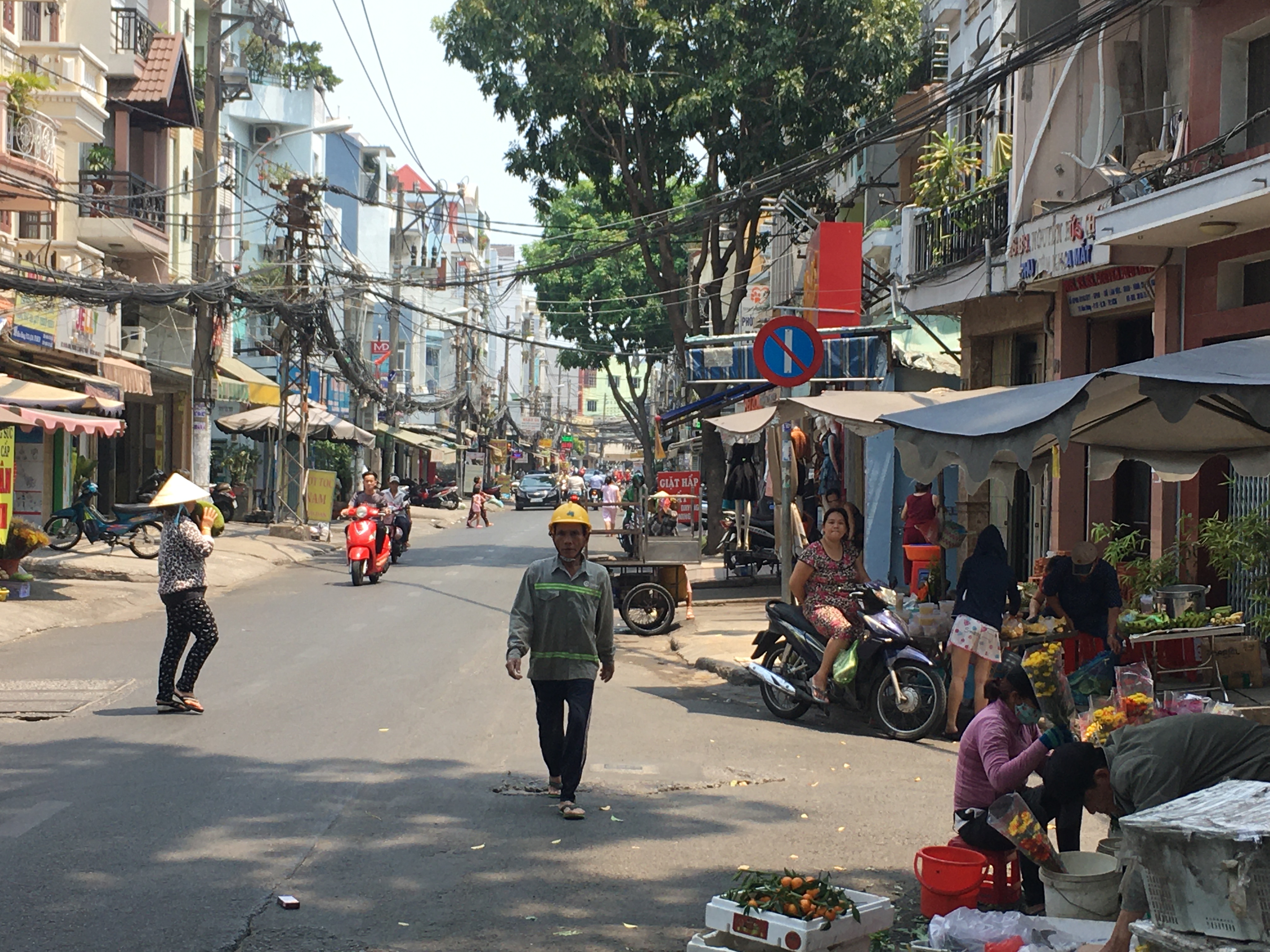
Hòa Hưng Street, District 10. A rare quiet moment around midday.
Horizontal Life
The first thing people notice in the photograph is usually the woman wearing the nón lá.
The traditional Vietnamese conical hat draws the eye immediately.
She is walking through a scene that contains almost every element of everyday urban Vietnamese life.
A construction worker in a yellow helmet is heading home or perhaps between jobs.
A woman sits casually on a scooter, perfectly balanced without either foot touching the ground. She looks relaxed, as if she has settled into waiting and is in no hurry for it to end.
A mother leads her daughter across the street.
Flower sellers prepare bouquets beneath simple coverings stretched out from the shops.
Buckets, stools, plants, baskets and produce occupy the edges of the frame.
Near the front of the image, oranges still hang from leafy branches placed on display for sale.
Further down the road, one of the familiar mobile vendor carts waits for the next part of its day.
Nothing dramatic is happening.
That is exactly why I love the photograph.
It captures a quality that is surprisingly difficult to describe: a street that feels busy and peaceful at the same time.
I should be honest and admit that I probably waited for a quieter moment before taking the photograph. Hòa Hưng was usually busier than this. The image was taken around midday, when activity had eased somewhat.
Yet the feeling was genuine.
Even when the road filled with more motorbikes, Hòa Hưng never felt frantic to me.
It never got old walking there.
Somewhere along that stretch was a small computer shop where I once sold a laptop.
I described the model to the young man working there and he quoted me a price. Later that day, on my way out for dinner, I carried the laptop back to the shop and handed it over.
He examined it for a moment.
Then he paused.
"Wait."
He pointed out that my model contained something different from what he had initially assumed. I never fully understood the technical explanation. More memory perhaps. Different specifications. Something along those lines.
He thought for a moment and then increased his offer by roughly a third.
Not because I had negotiated.
Not because I had argued.
Because he believed the laptop was worth more than he had first thought.
The honesty of the interaction floored me.
I still remember standing there trying to process what had just happened.
It felt entirely normal to him.
It felt extraordinary to me.
Years later, it remains one of the clearest memories I have of doing business in District 10.
The Trees
The trees are more important than they first appear.
Without them, the photograph becomes a completely different image.
The green canopy softens the street.
The trees create shade, cool the pavement and make the street feel habitable in the middle of the day.
They turn waiting into something comfortable.
It reduces the harshness of the tropical sun.
The eye naturally follows the trees down the length of the road.
They provide a kind of visual relief that is difficult to measure but impossible to miss once you notice it.
Years later, when I think about Hòa Hưng, I think about those trees almost as much as I think about the people.
Familiar Strangers
There was a man I used to see regularly on Hòa Hưng.
I never learned his name.
For months we seemed to pass each other on opposite sides of the street with such consistency that it began to feel statistically impossible.
He had long hair, which was unusual enough that I noticed him the first few times we crossed paths.
After seeing each other a couple of times we began nodding.
Then smiling.
Then chuckling at the absurdity of the situation.
We were complete strangers.
Yet somehow we had become part of each other's routines.
Whenever I spotted him on the opposite side of the road, I would look over and he'd already be looking back.
Neither of us ever seemed to be rushing anywhere.
I suspect he found the whole thing as amusing as I did.
There are friendships.
There are acquaintances.
And then there are people who simply become part of the landscape of your life.
Hòa Hưng seemed full of those relationships.
The Sound of the Neighborhood
The mornings arrived with sound.
A bánh mì vendor would move through the area broadcasting a recording through a small loudspeaker mounted to a motorbike.
The message echoed through the streets before gradually fading into the distance.
Later it would return from somewhere else.
The voice became part of the neighborhood's soundtrack.
So did another ritual.
Every morning around seven o'clock, the man living across from me on the ground floor would sit in his small garden and play music.
The songs sounded old.
Perhaps from the 1970s.
Vietnamese voices floated out across the alley and into the morning air.
The melodies carried a certain grandeur to them. Whether patriotic or simply popular music from another era, I never knew.
What I did know was that I enjoyed hearing them.
Nobody complained.
Nobody appeared bothered.
The music played for thirty minutes or so, then disappeared until the following morning.
Occasionally another family would bring out a karaoke machine.
Voices would drift across the neighborhood.
Then life would continue.
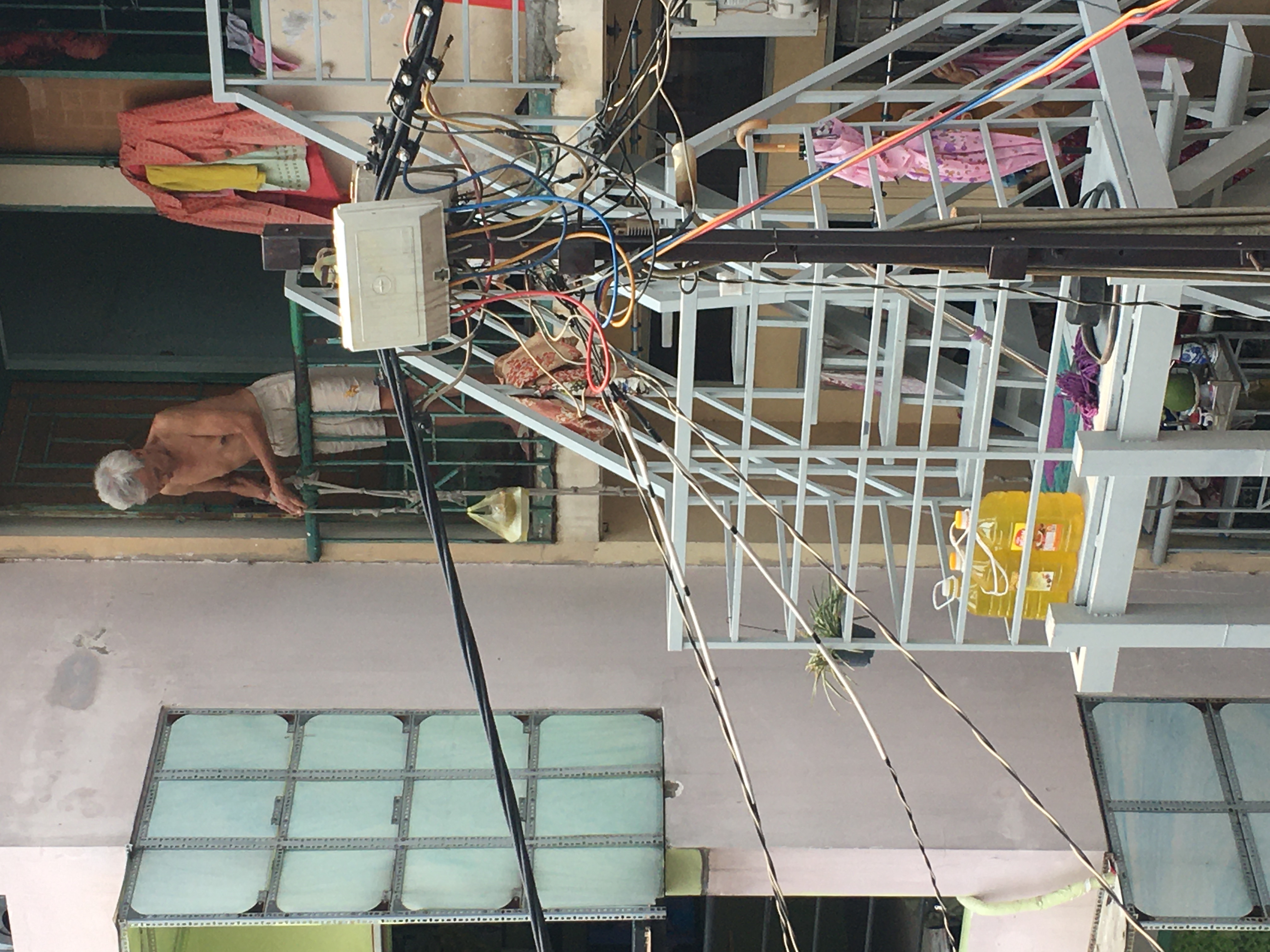
An elderly resident receives a takeaway meal on the fourth floor of a residential building in District 10.
Vertical Life
Across from my apartment stood a residential building occupied by multiple generations of the same family.
At least three generations appeared to share the structure.
Every morning and evening family members moved up and down the staircase attached to the outside of the building.
While the first photograph looks outward, the second one looks upward.
One day I looked out at the same time as the elderly man across the street was pulling lunch up to the fourth floor with a rope.
The plastic bag swung gently as it climbed, rising past stair landings, electrical cables, hanging laundry and concrete weathered by decades of tropical heat and rain.
The man stood shirtless on a narrow balcony, one hand on the railing and the other guiding the rope upward with the casual efficiency of someone who had done this many times before.
The moment lasted only a minute.
Yet it seemed to capture the entire logic of the building.
Nothing was wasted.
Every available space performed multiple functions.
The staircase moved people, but it also held jackets, cooking oil, umbrellas and laundry.
Landings became storage areas.
Railings became drying racks.
Balconies became delivery points.
The building extended beyond the apartment door.
Not because anyone had planned it that way.
Because that was what made daily life easier.
On quiet afternoons, animal sounds occasionally drifted from somewhere inside the building, reminders that household life and urban life often overlapped in ways visitors rarely expect.
The Family Across the Street
I never became close friends with the family.
But over time we became neighbors.
There is a difference.
The woman on the ground floor occasionally sold soft drinks from a small stand.
I would often buy one when passing by, partly because I wanted a drink and partly because I wanted to support her business.
Her son loved high-fives.
Every time I returned home there was a good chance he would appear.
Another small ritual.
Another familiar face.
I also discovered an unspoken system involving recycling.
Whenever I took out the trash, I made sure recyclable plastic bottles remained slightly visible near the top of the bag.
By the time I had reached Hòa Hưng and turned the corner, the bottles were often already gone.
No conversation was necessary.
No arrangement was discussed.
The exchange happened naturally and with dignity.
The Helmet
One afternoon a younger woman visited the family living on the fourth floor.
When she arrived, she carried her motorbike helmet upstairs.
At some point during the visit, the helmet slipped from the landing.
Neither of us saw it fall.
When she came downstairs later and couldn't find it, confusion quickly turned into a search.
From my third-floor balcony I could see exactly where it had landed.
The helmet had fallen several stories and become perfectly speared on one of the metal spikes decorating the fence below.
The fence belonged to the same household as the man who played music every morning.
I pointed downward.
She looked around.
Nothing.
I pointed again.
Still nothing.
Eventually she followed my finger far enough and finally spotted it.
The expression on her face was priceless.
Even now I smile when I think about it.
Not because it was important.
Because it wasn't.
It was simply one of those small moments that happen when people live close enough together to accidentally become part of one another's stories.
Why These Photographs Stayed With Me
The older I get, the less interested I become in cities as collections of attractions.
What stays with me are neighborhoods.
Specific streets.
Specific people.
Specific routines.
The photographs have remained with me because they capture both dimensions of life in this small corner of District 10.
The first photo captures horizontal life.
The flow of pedestrians, vendors, workers, parents, customers and strangers moving through shared space beneath the trees of Hòa Hưng.
The other photo captures vertical life.
The stacked reality of multi-generational households, external staircases, improvised solutions and the daily routines unfolding above street level.
The two photographs were taken only a short walk apart.
Yet together they feel complete.
One shows how the neighborhood moved.
The other shows how it lived.
Cities are often described through skylines, investment figures, transit systems and master plans.
But they are usually held together by smaller things:
- a clothes rack in a stairwell,
- shade from the trees,
- a vendor cart waiting for the afternoon rush,
- a woman in a nón lá crossing a familiar street,
- a child offering a high-five,
- a laptop buyer insisting on paying more than agreed,
- recyclable bottles quietly disappearing from a trash bag,
- music drifting through an alley at seven in the morning,
- an old man pulling lunch four floors upward on a rope.
Those are the things I remember from District 10.
And perhaps that is why these ordinary photographs have stayed with me for so long.
They are not photographs of famous places.
They are photographs of a neighborhood that welcomed me into its routines without ever making a point of doing so.
Years later, when I think about this corner of Saigon, I do not remember attractions or landmarks.
I remember horizontal life.
I remember vertical life.
I remember a place that felt remarkably alive.